Monday, March 23, 2009

Dow up 500 points due to government's plan


Written by: Tim Paradis
Posted by: Connie Yee

NEW YORK (AP) -- Wall Street got the news it wanted on the economy's biggest problems -- banks and housing -- and celebrated by hurtling the Dow Jones industrials up nearly 500 points. Investors added rocket fuel Monday to a two-week-old advance, cheering the government's plan to help banks remove bad assets from their books and also welcoming a report showing a surprising increase in home sales. Major stock indicators surged more than 6 percent, including the Dow, which had its biggest percentage gain since October.

Although analysts were still hesitant to say Wall Street is squarely on its way to recovery after the collapse that began last fall, they said the banking and housing news bolstered the belief that the economy is starting to heal.

"It's just hard to argue that there isn't an improvement in economic activity on the horizon," said Jim Dunigan, executive vice president at PNC Wealth Management.

The market began turning around two weeks ago on news that Citigroup Inc. was operating at a profit in January and February. A spate of more upbeat economic reports helped the market build on its gains, although the rally stalled last Thursday and Friday.

Click here to read more.


Workers Feel the Brunt of Health Insurance Woes


Written by Robert Wood Johnson
Posted by Chaoran Hu

American workers — whose taxes pay for massive government health programs — are getting squeezed like no other group by private health insurance premiums that are rising much faster than their wages.

Yet workers continue to pay the bill for covering others. Their payroll taxes help support Medicare, which covers the elderly. Income taxes and other federal and state levies pay for covering the poor and the children of low-income working parents. But government provides little direct assistance to help cover workers themselves.

If anything, the situation for workers appears to be worse than is reflected in the report. It analyzed Census data through 2007, the latest year available. But that before the economy tumbled into recession.

Goldman May Sell Part of Its Stake in Chinese Bank ICBC

Article Written By: Kate Kelly and Matthew Karnitschnig
Posted By: Madeleine Brooks

NEW YORK -- Goldman Sachs Group is considering selling part of its 4.9% stake in Industrial & Commercial Bank of China Ltd., a move that could raise more than $1 billion, according to several people familiar with the matter.

Talks between Goldman and ICBC about a sale began late last year and include potentially divesting 15% to 20% of the New York company's stake in the Chinese bank, two people with knowledge of the discussions said. Goldman's shares in ICBC are valued at about $7.5 billion. Any transaction would have to wait until late April, when a lockup on half the stake is set to expire.

The potential move comes at a delicate time for Goldman and other U.S. financial institutions that have received government aid in recent months. In addition to pressure to reduce risk taking and spending, such companies are facing tough curbs on compensation that could make it harder to keep top-performing traders and investment bankers from defecting to rivals. Since getting $10 billion in capital from the U.S. government last October, Goldman has made no secret of its desire to repay those funds. Trimming the stake in ICBC could help Goldman repay some of the aid.

Last week, China's Ministry of Finance made it more difficult for foreign institutions to buy or sell blocks of stock in Chinese financial firms, citing a need to protect national assets. The new rules, to take effect May 1, include a requirement that trades in Chinese financial firms by foreigners must be executed on a stock exchange at prevailing market prices. It is unclear whether those rules would affect Goldman's possible sale.

Click here to continue reading this article


An Insurance Game between AIG and Its Rivals?

By Chaoran Hu

The bailout for the insurance giant AIG was supposed to be used to stabilize the market, but now it causes another problem between AIG and its rivals.

Some AIG competitors have complained in the meeting at Riger Hotel in Washington DC that AIG is taking the advantage of the bailout to fend off rivals to keep or win contracts, which ranges from the U.S. Olympic Committee and an Arizona airport to an Illinois nursing home and a Florida town government.

However, The GAO said insurance regulators, brokers and buyers say AIG "may be pricing somewhat more aggressively than in the past in order to retain business," but the pricing didn't appear "inadequate." The GAO said it hadn't "drawn any final conclusions." And also, government needs AIG to retain competitive in order to repay the government.

So far, it’s hard to asset that is there really unethical usages of the bailout from government. And both sides are being aggressively at this period of time, but there is no evidence of yet a "systematic problem". "The competitors know AIG's in a vulnerable state....There are plausible stories on both sides."
References:

Treasury Unveils Toxic-Asset Plan, Citing 'Acute Pressure' on Banks


Article Written By: Maya Randall and Michael Crittenden
Posted By: Madeleine Brooks

WASHINGTON -- The Treasury Department unveiled its plan to use both private and public funds to take toxic assets off banks' balance sheets, and Wall Street cheered the news, sending the Dow Jones Industrial Average up 6.8%.

Acknowledging that the financial system continues to face "acute pressure" and is working against economic recovery, Treasury will try to address the real-estate-related assets that Secretary Timothy Geithner said is reducing banks' willingness to take risks and to lend money to consumers. The effort will be coordinated with the Federal Reserve and Federal Deposit Insurance Corp.

"This will help banks clean up their balance sheets and make it easier for them to raise private capital," Mr. Geithner said.

The plan calls for the federal government to work with private investors to try to restart the market for the troubled mortgage loans and securities, which in turn officials hope improves the financial condition of banks that have received billions in capital injections from the government already. The federal government will pair as much as $100 billion with private capital to generate $500 billion in purchasing power to buy the assets, and Mr. Geithner told reporters the plan could reach $1 trillion in size over time.

"We have to complement this program with a range of approaches to help get these securities markets back to a point where they're working again," Mr. Geithner told reporters Monday morning.

Click here to read more about this article

What Obama is Planning to do?


By: Li Bin Chen

As banks continued to fail, the Treasury unveiled its plan to wipe the banks clean of $500 billion worth of bad assets. After the announcement of the “Bad Asset” plan, bank stocks, among the most badly pummeled sectors in this recession, experience a stock surge. The stocks easily outperformed the 4% gains of the Dow Jones Industrial Average and Nasdaq. Citigroup is one of the banks that had some of the headiest gains with its stock surging more than 20% in the first five minutes of trading. Although these initial reaction were promising, but there were doubt about the future of the country. Due to the announcement, the stocks had surge but everything had to wait until the plan is actually put into practice. The Treasury still hasn’t seen any investors who are willing to buy these toxic assets.


The plan for Treasury to buy up billions in bad bank assets raised hopes that the economy is stabilizing. The stock reaction is a vote of confidence in the implementing of the plan. By getting rid of the bad assets, banks will not be limiting their lending and therefore prolonging the recession. Many economists had felt that stabilizing the banking system is the key to stabilizing the economy. By partnering with private investors, government hopes it can finally flush out toxic assets from banks’ balance sheets. The goal is to buy up at least $500 billion of existing assets and loans, such as subprime mortgages that are now in danger of default. The program could potentially expand to $1 trillion over time as the need increase.

Reference:


Obama highlights need for more clean-energy funding


Posted by: Stephanie King
Written by: CNN.com

President Obama turned his attention to the need for more clean-energy funding Monday, arguing that an expanded investment is needed to lay the foundation for long-term economic growth, cut dependence on foreign oil and slow the process of global warming.


President Obama speaks Monday on investments in clean energy.

Obama, speaking to a group of renewable-energy company owners and investors, said the country has "known the right choice for a generation (and that) the time has come to make that choice."

In the years ahead, the United States "can remain the world's leading importer of foreign oil, or we can become the world's leading exporter of renewable energy," Obama argued.

"We can allow climate change to wreak unnatural havoc, or we can create jobs preventing its worse effects. We can hand over the jobs of the 21st century to our competitors, or we can create those jobs right here in America."

He met with the owners and investors in the Eisenhower Executive Office Building adjacent to the White House.

Don't Miss
Stimulus may get small wind turbines spinning
Borger: Obama staking a lot on domestic policy
The recently passed $787 billion economic stimulus plan includes $59 billion in new clean-energy tax breaks, part of "the largest investment in basic research funding in American history," according to Obama.

The tax breaks, he claimed, will help create 300,000 new jobs and double the supply of renewable energy.

Obama also highlighted a proposed allocation of $150 billion over 10 years in new

For full article : click here

Should USA still be AAA?


By: Li Bin Chen


NEW YORK (CNNMoney.com) -- When the Federal Reserve announced last week it was buying $300 billion in long-term Treasury notes, the move was viewed as one of the safer bets the central bank has made recently.


After all, the Fed has either bought or announced plans to spend trillions of dollars on troubled mortgages and other types of questionable consumer debt in the past year. At the same time, the Fed has been loaning money to banks and companies that couldn't get funding elsewhere.
So the purchase of AAA-rated Treasurys, the highest credit rating that a bond can have, is probably the least risky thing the Fed can do these days.


Investors agreed: The prices of long-term Treasuries rose after the Fed's announcement, pushing their yields lower. (Bond prices and yields move in opposite directions.) Rates didn't even budge much Friday after the Congressional Budget Office raised its federal budget deficit forecast for this fiscal year.


When Does Life Insurance Make Sense?

posted by SooYeon(Pia), Shin

This financial protection can be particularly comforting when it comes to providing:

- protection for your family against financial hardship or to maintain their current standard of living.
- cash to pay off mortgages, taxes, or other debts so your heirs are not left with them.
- funds to pay funeral expenses.
- a continuing income stream for your surviving family members.
- an inheritance for your heirs.
- a nest egg for future expenses like your children’s or grandchildren’s education.

As you can see, life insurance is most applicable when you have dependents or heirs that you want to provide for. On the other hand, there are plenty of situations when life insurance does not make sense. For instance…

Click here to read more.

6 Tips to Save on Insurance Costs

Written by Philip Moeller
Posted by Chaoran Hu

1) Many seniors have older vehicles and do not need expensive low-dollar deductibles for collision and comprehensive coverage. Consider selecting higher deductibles. However, do not scrimp on liability protection or uninsured motorist coverage. More people are dropping their car insurance because of the tough economy, so you need to make sure you're covered should you be in an accident with an uninsured driver.
2) Some insurers have responded to last summer's $4 gasoline by expanding their reduced-driving discounts to better serve people who have cut back on their driving. If you do not drive many miles, you may qualify.
3) When you rent a car, odds are you do not need rental-car insurance and can rely on your existing car insurance policy to protect you. You will, however, be on the hook for the deductible payment should you be in an accident that is your fault.
4) Inflation protection is a must-keep feature of home insurance, but like millions of seniors who have downsized, you may have reduced your possessions. Review whether you still need special riders on jewelry, furs, computers, and other items.
5) Life insurance is designed to help loved ones, providing them money to replace the income lost by your death and helping to conserve assets in your estate should you have enough wealth to trigger estate taxes. As we age, the protective objectives of life insurance diminish and you may not need as large a policy.
6) Substitute generics for brand-name drugs. The U.S. Food and Drug Administration has a tool to identify generic equivalents of brand-name prescription drugs. Use it and see if you can save money.

Swoop and Squat, a Dangerous Form of Car Insurance Fraud


By Michael Collins

Insurance Fraud is a major problem in today's society. People will often hear stories about people burning down their houses or even killing spouses in order to collect insurance money. However, there is another form of insurance fraud that is not as common or as well-known: the Swoop and Squat, a form of auto insurance fraud.

AllState Insurance has publicized this type of fraud in commercials to help customers avoid becoming victims. Their website defines the swoop and squat as "Two vehicles work as a team to set up an accident. One vehicle pulls in front of an innocent driver and the other alongside, blocking the victim in. The lead car stops short, causing the victim to rear-end him. The car that pulled up alongside serves as a block and prevents the victim from avoiding a collision." So, the fraudsters essentially create a "controlled accident" that minimizes the risk to themselves, but will still get them a lot of money from the insurance companies, as well as causing the victim's insurance rates to go up.

Cities like Los Angeles and Miami have been known as hotbeds of swoop and squat rings. In addition, vehicles that are heavily insured, like tractor-trailers or expensive cars, are commonly targeted. If the fraudsters claim bodily harm (often faked), along with the damage to the car, they can make much more money with their scheme. Many rings have been known to involve corrupt doctors and lawyers, in order to verify injuries and get the cases through the court system.

This type of fraud is often difficult for drivers to avoid if confronted. However, insurance companies believe that the best ways to avoid becoming a victim are refrain from tailgating other cars, and to call the police as soon as an accident takes place.

References:
http://www.allstate.com/About/fraud.aspx
http://www.buy-and-sell-car-secrets.com/swoop-and-squat.html
https://www.nicb.org/cps/rde/xbcr/nicb.../13734_StagedFraud_Eng.pdf
http://www.justnews.com/news/18888799/detail.html

How to Safely Exceed FDIC Insurance Limits


Posted By Michael Collins

With the banking world back into doom-and-gloom mode, safety is the name of the game for investors and savers. Many of those looking to keep large amounts of cash safe have fled to 10-year Treasury bonds, which were yielding about 2.18% on Jan. 15. Of course, those investors face some capital risk if they sell the bonds. To play it even more safely, investors may consider three-month T-bills, but they were only yielding 0.10%. Six-month bills yielded 0.72%.

Meanwhile, on BankingMyWay, you can easily find a six-month CD yielding 3.00% or higher. But what about FDIC insurance?

The Federal Deposit Insurance Corp. has temporarily increased its basic deposit insurance limit for individuals to $250,000, but that is set to expire at the end of 2009. That will be here before you know it. What if you have deposits that exceed those limits?

You could spread your deposits across accounts at different institutions, but that would be an arduous record-keeping chore. And, of course, it would be a hassle to visit several banks or S&Ls. But the Certificate of Deposit Account Registry Service, or “CDARS,” can do this for you.

The service, provided by Promontory Interfinancial Network, has been available for six years. About 2,800 banks and thrifts in all 50 states offer the service, which allows CD depositors with balances of up to $50 million to have their entire balances insured by the FDIC. The number of participating institutions has increased 53% over the past year, not surprising when you consider that 25 banks failed last year.

Click to Read More

Sunday, March 22, 2009

Would You Rather Live in The North Pole or The Sahara Desert?


Supposed you only have two choices where to live, would you rather live in the coldest part of the North Pole or the hottest part of the Sahara desert? How would you cope with the extreme weather conditions? Please explain your answer.

Tags: North Pole, Sahara Desert, Extreme Cold, Extreme Hot, Global Warming, Ozone Layer, Choices

Posted by: Mel Avila Alarilla
Philippines
Viewpoint/Opinion


NBC News - Investing In Life Insurance

Posted By: Tsu-Han (Ina) Chang


Ten Things You Should Know About Life Insurance


Article by: CNN Money
Posted by: Madeleine Brooks

1. All policies fall into one of two camps.

There are term policies, or pure insurance coverage. And there are the many variants of whole life, which combine an investment product with pure term insurance and build cash value.

2. Insurance is sold, not bought.

Agents sell the vast majority of life policies written in the U.S. because the life insurance industry has a vested interest in pushing high-commission (and high-profit) whole-life policies.

3. Whole life is expensive.

Policies with an investment component cost many times more than term policies. As a result, many people who buy whole life often can't afford an adequate face value, leaving themselves underinsured.

4. Whole-life policies are built on assumptions.

The returns quoted by the agent are simply guesses - not reality. And some companies keep these guesses of future returns on the high side to attract more buyers.

Click here to continue reading the article

Saturday, March 21, 2009

Help! My policy's with AIG


By: Li Bin Chen

NEW YORK (CNNMoney.com) -- Question 1. If you have no credit card debt and have closed your credit card accounts, how can this hurt your credit score? - Nathan

First, how long you've used your cards accounts for about 15% of your FICO score. The longer history you have managing a card, the better your score will be.

Secondly, your FICO score also calculates how much credit you have in relation to your debt. By closing a card, you wipe away some of that available credit and that makes your debt look bigger - if you do carry debt at some point.

Some issuers are even closing down your credit cards if you don't use them often enough. So be sure to spread around your purchases on different cards so you avoid this situation.

Click here for full article

Wednesday, March 18, 2009

How to cut your car insurance

By JieYing Peng


With the U.S. economy in a crisis state, we are looking to cut costs whenever possible. One auto-related expense that could offer room for a trim is car insurance. According to insurance-industry experts, there are various ways to squeeze your coverage to yield up to a 50 percent cut in your annual insurance costs.
How?
1) Take advantage of discounts:
* short commute to work or school
* good student grades (above "B" average)
* multiple-car discount (2 or more vehicles on the same policy)
* prior coverage (having another policy in effect within the last 30 days)

2) Dropping your collision and comprehensive coverage. Cutting collision coverage is not so full with risk, however, especially if you own an older vehicle. As cars get older, their values obviously decline, and you may reach a point where the actual cash value is low enough that it is no longer makes economic sense to maintain that collision coverage

3) Keeping collision and comprehensive, but increase your deductible to $1,000 or more.

4) Dropping your uninsured motorists (UM) coverage.

5) Dropping your liability limits from "recommended" limits of 100/300/50 down to 25/50/10. (Many states have minimum liability limits of 25/50/10, but some require higher or lower minimum coverage depending on where you live). The trick is knowing how low you can go without leaving yourself vulnerable, with too little protection in the event of an accident.

6) Some consumers find that a good way to cut their insurance premiums is to just do their due diligence and comparison shop and switch from one insurance company to another based only on price.

Resources:
http://www.prnewswire.com/mnr/onlineautoinsurance/36512/
http://www.cnn.com/2009/LIVING/wayoflife/03/13/aa.insurance.discount/
http://money.cnn.com/2004/01/12/pf/willis_tips/index.htm?postversion=2004011309

What Three Wishes Would You Ask From The Genie of The Lamp?

You found the legendary lamp of Aladdin and the genie told you he will grant you three wishes. What three wishes would you want to ask from the genie? Please explain your answers.

Tags: Three Wishes, Aladdin's Lamp, Genie, Discovery, Wealth, Fame, Power, Happiness

Posted by: Mel Avila Alarilla
Philippines
Viewpoint/Opinion

Deciding Between Whole Life and Term Life Insurance


By Michael Collins

When choosing life insurance, one of the most important decisions that one must make is whether to purchase a whole life policy or a term life policy.

Whole life policies, once enacted, will cover the policyholder from that day until the day that they die. This is good for policyholders because they will no longer have to worry about dying unexpectedly and being uninsured. However, this comes with a price. Whole life policies are far more expensive than term policies, because lifetime coverage guarantees payment upon the death of the policyholder. Whole life insurance is essentially a savings account. The policyholder pays the insurance company throughout the duration of their life, who will pay the beneficiary upon the policyholder's death. Whole life policies are considered assets, so they can be borrowed against or surrendered early for cash.

Term life insurance are generally considered to be a more cost-effective option, especially for younger people. Terms can be anywhere from one to thirty years. Because the policy can expire, there is a chance that the insurance company will not have to pay, so rates are lower; although they get higher with age. A major drawback to term, however, is that it is not considered an asset and has no cash value.

Overall, both types of life insurance have advantages and drawbacks. However, I believe that term life insurance is superior, mainly due to the cheaper rates. Whole life insurance may be attractive, but the money that would go toward the high rates could simply be invested or put in a savings account by the policyholder and have a similar effect.

References:
http://www.wisebread.com/choosing-life-insurance-term-or-permanent
http://insurance.lawyers.com/Choosing-Life-Insurance.html
http://www.smartmoney.com/personal-finance/insurance/term-or-whole-life-8011/

Things That Insurance Can Do For You


By: Li Bin Chen

First, insurance provides disaster protection. The last thing anyone needs is to see their income or life savings jeopardized as a result of a death of the head of the household, a major home fire, or an automobile accident that leads to legal action. Events like these are traumatic itself, without the additional financial devastation.

Second, insurance can gives you peace of mind. It let you know that if anything happens to you, your family will be financially secure. Your back up plan had been set in place. This way you can relax a little more while you are on vacation, knowing that if someone should break into your home and carry off your property, you are covered. There are certain things in life that we pay for even though we may never use them and insurance is just one of such thing.

The range and scope of insurance policies are expanding all the time. The coverage that is available right now were unheard of a decade or two ago. Today, many insurance policies are aggressively marketed. The insurance policies had even extended far into the retail sector, where extended warranties have become part of their operation. These warranties are just another form of insurance; incase any new appliance breaks down after the manufacturer’s guarantee expires, you are still protected.

But some people tend to be carry away with the insurance products and end up buying policies that they don’t really need. Before spending a penny, always ask yourself if I don’t buy this policy am I putting myself and my family at serious financial risk from a genuine and common danger?

Risks on the Road


Posted by Connie Yee

In the current economy, families are being forced to cut cost from their finances even if it means late payments on their car insurance, or eliminating the insurance altogether. During the past year, several hundred thousand drivers have eliminated their car insurance or let the payment slides. The increase in canceling car insurance and insurance lapse is due to the sour economy and the rising auto-insurance rate. According to the Labor Department’s consumer price index, premium rose 3.8% in the past year.

For consumers who have no yet eliminated to lapsed on their car insurance payment, a good proportion have “stripped down their auto-insurance policies” and only having the absolute minimum level of liability coverage that is required to legally drive in their home state. The number of uninsured motorists in the United States is developing a major risk for everyone, those who are insured and those who aren’t. In the case of a hit by an uninsured driver, an insured driver would not be able to recuperate the cost of damage unless he/she sues the uninsured. If the insured wins, the uninsured lose their assets in the court judgment. As well, driving without insurance is illegal in 48 states and the District of Columbia. The only states that is legal to drive in without car insurance is New Hampshire and Wisconsin.

Tuesday, March 17, 2009

Flood insurace policies

Posted by SooYeon(Pia), Shin

According to the Federal Emergency Management Agency, there are many myths about flood insurance. One of the myths is that people who live in a high-risk flooding area cannot buy flood insurance. The truth is if the county participates in the insurance program, all of the county residents can purchase insurance freely. Another myth is that when it is already flooding, people cannot purchase a flood insurance policy. But, people can actually purchase the policy anytime though there is a 30-day waiting period after the first premium payment. The other myth is that federal disaster assistance will pay for damages when a home is flooded. However, the federal disaster assistance usually is “low-interest loan and may only be available to people in disaster areas designated by the president (Nance).”


You would be surprised to realize many things you think you have known are wrong when you are dealing with claims under flood insurance policies. Unlikely other insurance policies, the amount of litigation concerning claims under flood insurance policies was fairly low. However, began with Hurricane Katrina in 2005 through Hurricane Ike in 2008, the litigation involving claims under flood insurance policies were exploded. Failure to procure flood insurance was a central issue. Therefore, attorneys, insurers, insureds, and the courts have confronted issues about “unique and peculiar to flood insurance claims that had not been fully addressed in the past or which were not widely understood (Redfearn).” March 16th through 20th is Flood Safety Awareness week. So, including Missouri, the state emergency management agency is encouraging the residents to buy flood insurance policy because of melting snow and coming up of April showers.

http://www.insurancejournal.com/news/southcentral/2009/03/17/98791.htm
http://www.emporiagazette.com/news/2009/mar/17/flood_insurance_facts_and_fallacies/
http://www.ktbs.com/news/Buy-now-to-avoid-flood-of-problems-later-27881/
http://www.hannibal.net/news_local/x110653688/State-encourages-flood-insurance

Working for a large firm can decrease cost of health insurance

By: Tsu-Han (Ina) Chang

If looking for health insurance is important to you, and it should be; you might want to consider working for a large firm. Although this might be easier said than done, it is extremely important to take into consideration health insurance benefits as a main criterion of the job searching process. According to the U.S. Department of Health & Human Services’ Agency for Healthcare Research and Quality, there are three major trends in cost and access that affect employer-sponsored health insurance selection for employers and employees. The first trend is the size of the firm. Typically due to the size and employment of larger firms, insurance companies are able to offer better rates to the firm and its employees. Therefore, employers at large firms are more likely offer health insurance to its employees than smaller firms. The second trend is the contribution and wage level. The Boston Business Journal reports that there is a direct correlation in the relationship between the employees’ contribution/salary and enrollment in insurance. As previously mentioned, insurance is considered to be extremely important in that it protects its policy holders from having to pay high amounts of healthcare costs that would of otherwise occurred. However, if the premium contribution for the policy is high, the employee will most likely choose not to purchase insurance. Therefore in larger firms, where the company is able to contribute more to the policy, employees are encouraged to purchase a health insurance policy. The third and final trend is actually a list of characteristics of those looking to be covered by corporate insurance policies. The characteristics are as follows:
-Minorities
-Young Adults (19-24)
-Elderly working women with health problems
-Retirees

References:
http://www.ahrq.gov/research/empspria/empspria.htm#firms
http://www.ehow.com/how_138961_choose-health-insurance.html
http://boston.bizjournals.com/boston/stories/2008/03/24/smallb3.html

Flooding: It Can Happen to You


Posted by: Madeleine Brooks

By definition a flood is " a great flowing or overflowing of water". A flood can be a condition in which two or more properties/two or more acres of normally dried land is overflowed with water and/or mudflow. What causes a flood to occur? There are several different items that can cause a flood to happen. Here are the most common causes of flooding:

  1. Heavy Rain
  2. Spring Thaw
  3. Tropical Storms and Hurricanes
  4. Levees and Dams
  5. New Development of Land
  6. Flash Floods
Flooding can occur just about anywhere. There are flood maps called "Flood Insurance Rate Maps" also known as FIRMs that layout different flood levels. FIRMs break it down into three categories of flood levels. The first is High Risk Areas that have a 1% chance of flooding annually and that estimates to around a 26% chance of flooding over a thirty year mortgage. People in High Risk Areas are required to buy flood insurance. On a FIRM, these areas are marked with the letters A or V. The second flood level is called Moderate to Low Risk Areas also known as Non-Special Flood Hazard Area. There is a lower percentage of flooding to occur annually but its not removed from possibility. Areas that are moderate to low risk are not required to purchase flood insurance but it is always recommended in case that rare occurence does happen. On a FIRM, these areas are marked with letters B, C or X. The last flood level is called undetermined risk areas where there hasn't been an analysis of flood risk. Flood insurance rates reflect the uncertainty of a flood happening and these areas are marked with the letter D on the FIRM.

So, how do you know if where you are living is in any of those three flood levels? The government agency called the Federal Emergency Management Agency (FEMA) was created "to reduce the loss of life and property and protect the Nation from all hazards, including natural disasters, acts of terrorism, and other man-made disasters, by leading and supporting the Nation in a risk-based, comprehensive emergency management system of preparedness, protection, response, recovery, and mitigation." FEMA gives the proper precautions to take so one can plan ahead in case of a flood. Click this link to read up on the information FEMA gives. FEMA drew up FIRMs so that when people are looking to live places they know what the flood levels are in that community. To find a flood map you must look up your state, the county you live in and the district/community you reside in. Once you know all three of those items you can click to upload a flood map so see the risk you are at. If you want to look up the area you live in and what the flood risk you are at click here.

Hopefully this will give you more insight on what you can expect if you are in a flood-prone area and what actions you must take to survive a flood.

References:

http://www.floodsmart.gov/floodsmart/pages/flooding_flood_risks/ffr_overview.jsp
http://www.floodsmart.gov/floodsmart/pages/flooding_flood_risks/what_causes_flooding.jsp
http://msc.fema.gov/webapp/wcs/stores/servlet/CategoryDisplay?catalogId=10001&storeId=10001&categoryId=12001&langId=-1&userType=G&type=1&dfirmCatId=12009
http://dictionary.reference.com/browse/flood
http://www.fema.gov/about/index.shtm

Insurance in China

Written by Celent
Posted by Chaoran Hu

China is fast becoming one of the world's most important economies. Although its financial services sector is still small compared to the US, Europe, or Japan, its rapid growth rates and huge potential size make it a critical arena for expansion for both insurers and solution providers. Celent’s latest report, Insurance in China: Market and IT Overview, provides an overview of this important market and a high-level look at some of the key organizational and IT-related issues for both local Chinese and foreign insurers. Future Celent reports may examine specific elements of this market more closely, especially the roles and positions of local and international solution providers.

Since 2000, the Chinese insurance market has tripled in size to about US$60 billion in premium, and Celent estimates that it is on track to exceed US$100 billion by 2009. IT Spending currently accounts for approximately 3.5% of premium, but Celent projects that this will rise to 5% of premium by 2009 as insurers continue to build out their increasingly complex IT infrastructures. "As Chinese and foreign companies compete in this market, they face different organizational and technological challenges. Chinese companies have an advantage with their market knowledge and especially with their relationships with regulators, but are hampered by underdeveloped business practices and technology," comments Matthew Josefowicz, manager of Celent’s insurance group, and lead author of the report. "Foreign entrants are typically further advanced in those areas, but must adapt to a new market which operates differently from the more mature markets that many are used to dealing with."

Ban Young Drivers From Using Hands-Free Phones, Says Yes Insurance

Article by: Yes Insurance
Posted by: Madeleine Brooks

LONDON, UNITED KINGDOM - Teenagers in the UK who use hands-free mobile phones whilst driving are taking risks that equal those of drink-driving, according to motor insurer yesinsurance.co.uk (www.yesinsurance.co.uk).

The insurer issued a statement today saying that the current law relating to driving and mobile phone usage should be amended to include a ban on using hands-free phones for drivers aged under 20.

"There is a growing body of research that indicates that drinking alcohol and using a hands-free mobile phone carry similar levels of risk," says Paul Purdy of yesinsurance.co.uk.

Research conducted at the Transport Research Laboratory has found that drivers talking on both hand-held and hands-free mobile phones have on average 30 per cent slower reaction times than those who have been drinking, and 50 per cent slower times than sober drivers.

Click here to read more

Monday, March 16, 2009

Know Your Insurance Policies


Written by Robert Powell
Posted by Connie Yee

BOSTON -- It might not be the stuff of cocktail-party chatter, but insurance is certainly a topic worth talking about. That's especially true now, given the dramatic changes in the insurance industry, the stock market and perhaps in your own life over the past few months.

Here's a look at three insurance to-dos for this year.

Life insurance

Time was when not owning life insurance was the risky move. Now, however, owning insurance seems like it's the greater risk. Insurers are under pressure and experts say you should pay close attention to your various life insurance policies. AIG is, of course, a well-known problem. But others are facing stiff winds, too. Standard & Poor's lowered its counterparty credit and financial strength ratings on 10 U.S. life insurance groups, according to published reports. What's more, the rating agency reported that around 40% of insurers were on a "negative" outlook.

Click here to read more.

How You Can Save on Car Insurance


Posted By Michael Collins

Before you compare rates, check out these money-saving tips for your car insurance.

1. Earn a low mileage discount. If you work from home, carpool or use public transportation, look for companies with discounts for low mileage, pay-as-you-go, or carpooling. And, tell your current insurance company if you're driving less these days; rates may be lower if you drive less than 10,000 miles each year.

2. Increase your deductibles. You may save 10 percent or more on your comprehensive and collision premiums if you increase your deductible from $250 to $500. And, if you car is really old, it may be time to drop comp and collision coverage completely—but only if you're willing to pay for repairs yourself.

Click to Read More

Commentary: Obama should offer public health insurance to all

Posted by JieYing Peng


President Obama should provide all Americans the choice of a public health insurance plan like Medicare. He shouldn't just leave us a choice of private insurance companies, none of which could offer decent coverage.

The public health insurance option is attractive for several reasons.

First, it would lead the way in lowering administrative costs. It wouldn't need to make a profit. It wouldn't need to pay outsized salaries to administrators. Public health insurance programs have administrative costs nearly 10 percent below those of most private insurance policies, according to the Department of Health and Human Services.

Second, since a public health insurance option would not be under pressure to pay shareholders, it would be more able to invest in quality health care through prevention and in advising doctors about the latest research on the most effective treatments – rather than on the most profitable ones.

Read Full Article: http://www.mcclatchydc.com/commentary/story/63896.html

Aging Well: Good preparation gives older travelers peace of mind


posted by SooYeon(Pia), Shin

Most people think about travel insurance when they worry about having to cancel a trip.

However, travel insurance also is available for medical costs if a traveler becomes ill or injured or needs ambulance or air transport to a medical facility.

Most Americans who purchase travel insurance choose comprehensive policies that cover medical and medical evacuation expenses in addition to trip cancellation and lost or damaged baggage, according to the US Travel Insurance Association.

Travelers should investigate whether their health insurance will cover medical costs abroad and if so, what would be covered, such as hospitalization and emergency care. Medical evacuation, which can cost thousands of dollars, rarely is covered by most standard health insurance policies. Also, Medicare and Medicaid do not pay medical expenses outside the U.S.

Travel insurance prices generally are based on a person’s age, cost of trip and amount of coverage. Most policies range between 4 and 8 percent of the total trip price, according to the association.

Annual policies also are available for frequent travelers.

Click here to read more.

Sunday, March 15, 2009

Keeping your belonging in a Safe?

By: Li Bin Chen

NEW YORK (AP) — As the nation's banking industry inhales billions of dollars in government support, the urge to hoard your cash at home might be pounding mightily.

You wouldn't be the only one, judging from the recent spike in sales of home safes.

Keeping loads of money around the house remains an ill-advised step, but a home safe can still be a way to guard against fires, floods and burglaries. Cherished old photos, legal contracts and passports can be difficult to replace.

The key to buying the right safe is knowing what threats you want to guard against. Ultimately, no safes are foolproof — they simply come with varying degrees of protection.

"Safes are like insurance — the more protection you want, the more it's going to cost," said Jim Riccardi, east coast sales manager for Gardall Safe Corp., based in Syracuse, N.Y.

You won't be the only one putting your belongings in a safe.

SentrySafe, the nation's largest safe manufacturer, said sales were up as much as 50 percent over the last five months. They've since leveled off, but were still up as much as 10 percent in the first week of March from the same time a year ago, according to the Rochester, N.Y.-based company.

But before you join the rush, here's what you need to know.

Click here for full article

Should You Buy Pet Insurace?

By Chaoran Hu

With the incredibly increase of the vet bills, and availability of new treatment for the pets, most people will face a hard time in paying off the high veterinary costs. Therefore, they have to consider insurance for their pets in order to reduce the costs. Pets insurance means coverage of the veterinary costs once the pets become ill and get injured by some accidents. Some policies will also pay out when pet dies, gets stolen or lost.

Assuming that your pet becomes injured, he may require surgery to survive. That would cost you around $2000-$3000 to heal them of their sickness. Most people can't afford that at one time, which becomes a problem for them. And at this moment, you have to make a decision that whether you want to save the life of your pets.

Let's take a look at what will be covered in a pet insurance:

Routine Care Coverage: Annual physical exams vaccinations Heart worm detection & treatment spay/neuter procedure teeth cleaning prescription medication for flea control general, comprehensive health screen Some Pet Insurance providers offer veterinary HMO/PPO plans that cover these issues. Others offer more coverage that includes professional consultation, de worming, fecal tests, and microchip identification.

Therefore, pet Insurance could be the solution for you. While pet insurance covers 1/8 of all pets in the UK, less than 1% of US pets are covered by some form of pet insurance. However, more and more Americans are taking out pet insurance on their animals. The reasons are costs, and your care to your pets.

References:

http://uk.insurancewide.com/insurance/pet/news/2009/february/call-for-more-owners-to-invest-in-pet-insurance-20000131/

http://www.insurancetraders.com/specialty/pet.html

http://www.pet-insurance-info.com/WhatItCovers.html

Eliminating Private Mortgage Insurance

Posted By: Tsu-Han (Ina) Chang

Friday, March 13, 2009

Which Country Would You Want To Be Relocated To If Given A Lucrative Job?


If you are given the privilege to relocate yourself and your whole family because of a lucrative job, which country would you want to be relocated to? Are you willing to be permanently resettled to that country? Please explain your answer.

Tags: Relocation, Family, Lucrative Job, USA, Canada, Australia, UK, Germany, France, Italy, Switzerland, Belgium, Spain, Sweden, Russia, China, Japan, Taiwan, Singapore, Hongkong, Saudi Arabia, United Arab Emirates, South Africa

Posted by: Mel Avila Alarilla
Philippines
Viewpoint/Opinion

Wednesday, March 4, 2009

Flood insurance


Posted by SooYeon(Pia), Shin

Tour Stop 1: Who sets the rates?
The flood insurance rate is set by the Federal Emergency Management Agency (FEMA). The rates are exactly the same in the U.S..

Tour Stop 2: How are flood zones rated?
There are three flood zone ratings: A, V, and X.
-“X” means you are not living in a flood plain zone, so rates are lowest;
-“A” is one step up – you are in a flood plain zone and the primary concern is a rising water table. A standard “A” policy costs $2,766/year for $250,000 in flood insurance coverage plus $100,000 for contents. Often, “A” zone is referred as “AE” where “E” means elevation.
-“V” is the highest level. “V” stands for velocity, meaning the property can be damaged by water driven. “V” rates are most expensive.

Tour Stop 3: What zone are you in?
The builder is responsible to prepare an elevation certificate which tells the owner of the house what zone she is in. If the owner takes out a mortgage, the bank will ask her to bring the flood insurance, and the agent will let her know the rate. When there is change in rates, the rates would be changed or stayed same depending on circumstances.

So what should a homeowner have to do?
Step 1: Find out whether you are currently paying for a flood insurance. If you are, go to step 2. But, if you are not and want to have a policy, call to your insurance agent!

Step 2: Check if your rate has increased over 4 to 5 years. If so, try step 3. If not, you are safe.

Step 3: Ask your insurance agent and find out ways to lower your rate.

Step 4: Be persistent. Make sure that you are getting the lowest rate possible in your situation. If you have further question, call FEMA at 770-220-5200.

Flood insurance does not take effect for 30 days after the policy are purchased.


http://www.kxmc.com/News/339781.asp
http://www.inforum.com/event/article/id/232975/
http://www.thedanielislandnews.com/artman2/publish/Top_Stories_69/Flood_Insurance_Are_you_paying_too_much.php

Are You Covered for Natural Disaster?

By Connie Yee

Homeowners may not aware that some natural disasters are not covered by their home insurance policy. For those who live in any floods, earthquakes, landslides, wars or nuclear prone areas, purchasing extra insurance policies may be beneficial. However, homeowners tend to ignore purchasing extra policies because of the high premium and limited coverage. To understand which policies are important and how to purchase them, please read below.

Earthquakes: Typically, the policy is 10-15% deductible but have high premiums that can cost more than $2000 (annually). Homeowners in high-risk locations can purchase the insurance from private companies and state-run insurance pool such as the CEA (California Earthquake Authority).

Floods: The policy cost between $500 to $1000 annually depending on the location of the home. However, the insurance would be useful only if it was purchase 30 days before the natural disaster occurs. Homeowners can purchase the flood insurance from the National Flood Insurance Program or private companies.

Hurricanes: Typically, the policy is 2-15% deductible. Policy tends to vary by state. In state such as Alabama, Florida, Louisiana, Mississippi, etc. the government provides windstorm coverage for those who cannot afford private coverage.
References:

Who Is Your Hero?


Who is your hero? Who is the person that embodies all the attributes you want in your hero? Please explain your answer.

Tags: Hero, Heroine, Image, Role Model, Icon, Pedestal, Hero Worship, Fan, Idol, Footsteps, Life

Posted by: Mel Avila Alarilla
Philippines
Viewpoint/Opinion

Tuesday, March 3, 2009

Health Insurance: Requirement for College Enrollment


By: Tsu-Han (Ina) Chang

At Syracuse University, full-time students are required to pay a health fee regardless of whether or not the student already has health insurance. However, this does not mean that students should go ahead and cancel their preexisting policy. The assumption that the university’s or any universities’ across the country provide health services that are comparable to that of common health care insurance is false. The two are drastically different. Take for example the services offered by the health fee at SU, some of which include office visits, ambulance services, counseling center services, nutrition counseling, etc., but these are just very minor overages. Therefore, it is recommended for students to continue to have outside health care insurance in the case they need to go to a local hospital for more intensive treatments. Although insurance is costly, students can look for coverage under the same plan as his/her family. Typically this will save the student more money than if he/she were to look for independent/individual coverage. It is important to consider this options as student under the age of 23 can benefit from the savings under family health care insurance plans.

However, for those who are looking for coverage as an independent, here are some things to consider:
1. If you're covered on a parent's policy, try to continue this coverage if possible.
2. Seek coverage through your employer.
3. Find out if your college or university offers a more comprehensive student health plan. Colleges maybe be able to offer plans at a cheaper rate due to student status.
4. Locate other group coverage.
5. Determine whether you qualify for Medicaid.
6. Buy an individual policy from a private carrier.
7. Apply for coverage through the Health Insurance Risk Pool offered by your state.
8. Find low-cost health services in your area.

References:
http://students.syr.edu/health/faqs.html#general01
http://www.nytimes.com/2008/02/23/business/yourmoney/23money.html?_r=1&scp=5&sq=student%20insurance&st=cse
http://www.texashealthoptions.com/cp/students.html

Little Light in the Dark- Unemployment Insurance

By Chaoran Hu

When millions of employees are suffering from the great economy recession, unemployment insurance has become a safety net for workers who lose their jobs. Unemployment insurance was created in 1935 in response to the great economy recession at that time. Now, the program helps cushion the tremendous impact of the economy downturn and bring economic stability to communities, states, and the nation by providing temporary income support for lay off workers.

However, the rules vary by states. Mostly, they will review the reason for unemployment before they issue the benefits. Recipients typically receive half of what they earned before laid off, and the effective time for the benefits is limited to 26 weeks, which may extend longer period for the 2009. The requirement for the claims is that they must have worked for a specific number of months in order to receive the benefit. In some states, the claims can be done by phone, mails, or internet. It usually takes 2 weeks for the benefit take effect, and in the following weeks, the recipients must continue to affirm that their eligibility t work and they are actively seeking new jobs.

After realizing the possibility of unemployment insurance, the employees who have been laid off will have some sort of insurance during their tough time. However, it is still not the ultimate goal, the only solution during the economy recession is to recover and restructure the unstable economy.
References:

Monday, March 2, 2009

What Obama's Health Care Plan Means for You


Posted By Michael Collins

Successful health care reform eluded both Presidents Bill Clinton and George W. Bush. It could be argued that one tried a bit harder at it than the other, but there's little question that the issue will command a significant amount of Barack Obama's attention after he's sworn into office--in large part because the people who elected him care so much about it.

Though 62% of voters ranked the economy as their chief concern, according to exit polls conducted Tuesday by the Associated Press and major television networks, 9% of voters listed health care as a primary concern. That trailed the number of voters worried about Iraq by only 1% and tied the percentage of those troubled by terrorism.

In Depth: Obama's Health Care Plan

Though some experts don't expect to see major changes until 2010, Obama's proposal has set the tone for a debate about how to cut rising costs while providing insurance to 45 million Americans. While certain elements of Obama's proposal could be modified, at its core are principles that would change health care delivery and coverage in the U.S.

Click to Read More

AIG – still not save from the bailout


By: Li Bin Chen

Nearly six months after American International Group Inc. got its first massive bailout from the government, it's still stumbling. Its shares are down 96 percent since its first bailout was announced. AIG keeps losing money even after the initial bailout and it is unable to sell some of its biggest assets. AIG, the insurer deemed too important to fail, may get a commitment for as much as $30 billion in new government capital after a record quarterly loss. They are expected to post a roughly $60 billion in quarterly loss largely due to write downs on certain tax assets and commercial mortgage backed securities. The deal with the U.S. government would ease the terms of its bailout, give a further equity commitment and help it pay down debt.

The government saves AIG once and it will save it again for the same reason: AIG is considered too big and too important to fail. If the government lets AIG fail, it will sent enormous shock across all industries because AIG had hold portfolio in different areas. This shock will reflect an even sharper decline in the current stock price which the United Stated government is trying its best to save.

The government will swap the 80 percent stake it currently holds in AIG for even bigger pieces of the three units that would be split off from the company: AIG's Asian operations - Asia-based American Life Insurance (Alico), its international life insurance business - American International Assurance Co (AIA and its U.S. personal lines business. In return for the breakup, the government would relax the terms, or cancel, a portion of the $60 billion loan that was at the center of a restructured $150 billion rescue package


References:

Do you need travel insurance?

By Peter Greenberg
Posted by Chaoran Hu

According to the U.S. Travel Insurance Association, about 30 percent of Americans purchase travel insurance, an increase from 10 percent before 9/11. The top three reasons are: peace of mind, protection against the unexpected and concern over losing the financial investment in a trip. Some 70 percent of cruisers buy travel insurance.

Reasons to buy travel insurance
1. Your flight has been cancelled.
2. Your bags are lost and your medication is in it. You need to have an emergency prescription filled.
3. Your passport and wallet are stolen, and you need emergency cash and a replacement passport.
4. You're involved in an accident and adequate medical treatment is not available. You need medical evacuation.
5. You need to cancel your trip due to illness.
6. Your cruise line, airline or tour operator goes bankrupt. You need your non-refundable expenses covered and to get to your destination.
7. You have a medical emergency in a foreign country.
8. A terrorist incident occurs in the city where you’re planning to visit and you want to cancel your trip.
9. A hurricane forces you to evacuate your resort, hotel or cruise.

Fradulent Unemployment Claims


Written by Brian Ettkin
Posted by Connie Yee

ALBANY Stephen Wyllie has investigated dead people who have seemingly been resurrected just in time to claim unemployment insurance benefits.

He has found prisoners who were receiving unemployment benefits.

"It's kind of hard to be ready, willing and able to work when you're locked up in Attica or Franklin Correctional Facility," said Wyllie, assistant director of the special investigations unit of the state Department of Labor.

One time Wyllie even busted a Department of Labor employee who was committing fraud by filing a false claim under his mother's name and collecting the benefits unbeknownst to her.

Little wonder the special investigations unit found nearly $30 million in fraudulent claims in 2008 about $14 million of which has been paid back and 22,760 instances of willful misrepresentation. In 2008, it received 31,879 referrals and tips, mostly from employers, ex-partners, jilted lovers and cross-match queries.

Click here to read more.

Not an employee? Dealing with the health insurance conundrum

Posted by JieYing Peng

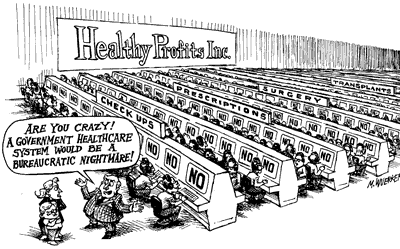
I was giving an interview on freelancing this week, when the reporter stopped me and said, "I have a tip for people who want to freelance: Make sure you marry someone with good health insurance."

People who aren't traditional full-time employees get this advice a lot. And not just freelancers, but part-timers, contractors, temps, and full-timers whose employers don't offer insurance benefits in the first place. And this "you'd better marry for medical coverage" line never fails to annoy us.
Single Shot columnist Diane Mapes wrote in the Seattle P-I this past week about the high rate of people who hasten their nuptials because one person needs the health insurance. As Mapes reports, of those couple who legally can marry, the need for health coverage accounted for 7 percent of knot-tying in 2007.

Read Full Article:

http://blog.marketplace.nwsource.com/ninetothrive/2009/02/not_an_employee_the_health_ins.html?cmpid=2308

U.S. readies another $30B as AIG debt problems mount


posted by SooYeon(Pia), Shin

The government is preparing to offer AIG access to as much as $30 billion in new cash to keep it alive, according to several people with knowledge of the deal who spoke only on the condition of anonymity because of the sensitivity of the matter. In addition, the government will convert its previous investment in so-called preferred shares into shares that don't receive a dividend payment. Also, the government will gain a stake in two of AIG's insurance subsidiaries as payment for $35 billion of previous loans.

Sunday, March 1, 2009

Mortgage Insurance: Harder to Get

Posted By: Tsu-Han (Ina) Chang
Written By: Bob Tedeschi
PRIVATE mortgage insurance, known to many as P.M.I., is a necessary evil for borrowers who cannot afford the 20 percent down payment often required by lenders. But now, with losses mounting within the mortgage-insurance industry, some applicants are being turned away, while others will have to pay higher premiums.

At least five of the six major insurers recently changed their policy qualifications. One of them, the PMI Group, which is based in Walnut Creek, Calif., said in February that it would no longer insure mortgages obtained through brokers, and it stopped offering private mortgage insurance for condos and other attached-housing units.

Meanwhile, the Mortgage Guaranty Insurance Corporation of Milwaukee said that it would no longer insure cash-out refinance mortgages and mortgages for second homes or manufactured homes.

Boomers - path to survivial


By: Li Bin Chen

NEW YORK (CNNMoney.com) -- What a turnaround for the American Dream!

According to a report released Wednesday, the real estate market bust and stock market declines have carved a huge chunk out of the assets of baby boomers.

So much home equity has been lost that 30% of boomers, aged 45 to 54, are underwater in their homes, according to "The Wealth of the Baby Boom Cohorts After the Collapse of the Housing Bubble. " The report, released by D.C.-based think tank the Center for Economic and Policy Research, also found that 18% of boomers aged 55 to 64 would owe money at close if they sold their homes.

The CEPR also found that people who were renting homes in 2004 will have more wealth in 2009 than those who were owners. That's true for all five wealth groups the study analyzed, from the poorest to the wealthiest.

Click here for full article